Tuesday, November 30, 2010

Wunderbar in Winter: 10 Things to do in Germany

Germany is deservedly famous for its Christmas markets. However, there’s a lot more for cold-weather travelers than just this.

Germany offers great outdoors in winter, with quirky attractions and things to do that will warm both body and soul. German travel experts from GermanyisWunderbar.com introduce 10 things to do in Germany during winter.

Ski Bavaria
Germany is only a little brother to the big siblings France or Austria when it comes to skiing holidays. This, however, makes it an insider’s tip for skiers open to something different, less crowded, less commercial and more cosy. 

Bavaria features the widest choice of slopes, with the Zugspitze in Garmisch-Partenkirchen, Germany’s highest mountain. In south-west Bavaria, the Allgäu with villages like Oberstdorf and Oberstaufen is Germany’s largest skiing area with 500km of slopes, cosy mountain huts included. And there has already been lots of early snow this year!

Christmas markets
Germany in winter is Christmas market country. From the end of November up until Christmas, it’s all about sparkling lights, Christmas trees, handicrafts, hearty food, sweet treats and mulled wine. One way to explore a variety of markets is a Christmas market cruise. On the Rhine, visitors can sample one or even seven markets in Cologne or make a short trip to Heidelberg, home of Germany’s oldest university where the market spreads across five different little squares. Christmas market cruises on the Danube start near Nuremberg, arguably Germany’s most famous Christmas market, but also well known historic cities like Regensburg and Passau on the Danube, both beautifully preserved, make enchanting picture perfect Christmas market settings. Check here for some great itineraries visiting the German Christmas Markets.


Want to cook some German Holiday Specialties and afternoon delights? Here is a list!

Black forest gourmet heaven
Everyone feels more hungry in winter. Baiersbronn in the Black Forest is a real treat for every food lover, featuring seven Michelin stars divided up between three restaurants. Foodies will also enjoy the abundance of home-made products such as Black Forest hams, schnapps and honey or a visit to the local chocolate factory. Baiersbronn is also a top winter destination for skiing or hiking on a wide variety of special winter trails.

Breweries of Bavaria
Here’s an idea: warming up in winter while sampling beers in Bavaria. Many breweries in the south of Germany have been turned into destinations for visitors, offering brewery tours and providing accommodation.

Visiting breweries in Bavaria also comes with the added benefit of exploring some of Germany’s oldest and prettiest towns such as Bamberg where the Fässla brewery has been going since the 17th century. Just in case you’re worried, all of those places have lovely Christmas markets as well.

Stollen sampling in Dresden
Stollen and Christmas in Germany go hand in hand. You could buy this special cake at your local Lidl but it’s much better sampled in Dresden where it was invented more than 500 years ago, its shape symbolising the baby Jesus. As things are done properly in Germany, there’s an official association of Stollen bakers and all of the 150 bakers are based in the Dresden area. 

The city on the Elbe is full of historic attractions and in winter, live revolves around the Striezelmarkt, one of Germany’s oldest Christmas markets. Or experience the city while cruising on one of the old paddlesteamers run by Sächsische Dampfschiffahrt who offer tours throughout winter.

Narrow-gauge railways in the Harz
Criss-crossing the Harz, the Harzer Schmalspurbahnen railways connect the cities of Wernigerode, Nordhausen and Quedlinburg in proper vintage style. The narrow-gauge railways are Europe’s longest historical rail network and feature steam locomotives for some good old huffing and puffing up the mountains.

The trains provide a year-round service for the local communities and a trip in winter through the snow covered Harz mountains makes for a special travel experience. Just thought we’d mention it, Quedlinburg is not only a UNESCO world heritage site full of half-timbered houses but also features a delightful Christmas market.

Nürburgring racing circuit and motorsport adventure land
This is something for the family (ok, for the boys): The Nürburgring in the Eifel, one of Europe’s most famous motor-racing circuits, has been transformed into an all-year motorsport themed adventure zone in recent years, perfect to animate those dark winter days. The ring°werk is a mixture of science/theme park and museum; there’s a cart track, backstage tours of the racing circuit are offered, and a number of hotels right next to the Nürburgring provide accommodation.

Most importantly, racing enthusiasts can have a go for themselves on the Nordschleife circuit open to the public.

Industrial tourism in the Ruhr area
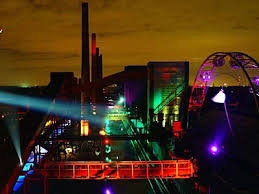
The Ruhr area is Europe’s unlikely Capital of Culture 2010 and trailblazer of industrial tourism. Germany’s former industrial heart has turned its obsolete blast furnaces and coal mines into spectacular visitor attractions. The most dramatic of the conversions is Essen’s elegant Zeche Zollverein coalmine, a UNESCO site attracting a million visitors per year. In the run-up to Christmas the site invites visitors to experience a special Christmas atmosphere: Industrial architecture meets seasonal events and a traditional Christmas market.

Coffee & Cake
The German tradition Kaffee & Kuchen is experienced at its best in winter time when cosy cafés invite visitors to spend long hours indoors, drinking coffee and eating cake. Cafés come in different styles, some more old-fashioned, others very trendy. There are some famous and old-established ones like Café Niederegger in Lübeck or Zum Arabischen Coffe Baum in Leipzig. Some are local favourites in smaller towns to be discovered by the discerning travellers. Rest assured, sooner or later you’ll end up in one.

Winter city breaks
Germany's cities are perfect for avoiding winter gloom with stylish hotels and restaurants, world-class museums and great shopping. In Berlin, seasoned travellers could go for a lifestyle tour to explore the trendy side of the capital . Couples looking for a romantic break will find Heidelberg a rewarding destination. And youngsters with little to spare can benefit from stylish budget accommodation anywhere in Germany. Last but not least and suitable for everyone: The Christmas markets. Just in case, you’d forgotten.


Call us for more ideas and itineraries and take advantage of the low airfares during the Winter time.


Want to cook some German Holiday Specialties and afternoon delights? Here is a list:

Friday, November 19, 2010

Christmas in Germany - including traditional Christmas Markets & Recipes

There are so many wonderful things to see and do in Germany at Christmas. Stroll through festively decorated streets and explore the enchanting Christmas markets with their seasonal music and choir singing. Listen to the sounds of bells and trumpeters and attend one of the many concerts from classical to gospel in the churches and on outdoor stages. Adorned with decorations and festively lit, the pedestrian precincts and shopping centres offer everything your heart could desire. The arts and entertainment scene also takes a seasonal turn in December: in Germany’s major cities, you’ll find everything from plays, operettas and musicals to spellbinding readings. In addition, theme parks are open throughout Christmas for their winter seasons – take the whole family to magical Europa-Park Rust, a winter wonderland in white brimming with thrills, spills and surprises. There are also numerous winter sports you can get involved in and high-profile events such as the New Year ski jumping in Garmisch-Partenkirchen. You see, it’s not just Christmas trees and twinkling lights, Germany has something for everyone during the festive season. Click here for more information on the best 10 things to do in Germany during Winter.


Some of the German Specialties Recipes for the Holiday Season:


Christmas baked apples:


Ingredients: 4 large, tart apples 10g (1 tbsp) butter 4 tsps raisins Flaked almonds Honey-water mixture To prepare: Wash the apples, then remove the stalk, the core and the pips with an apple corer. Make a horizontal cut around each apple so it won't burst. Place in a greased shallow ovenproof dish then fill with raisins and flaked almonds. Sprinkle with cinnamon and pour honey-water mixture into the top. Bake on a low shelf at 200°C for approx. 30 mins. Leave the apples to cool, then serve.


Glühwein - mulled wine:


Ingredients: 1 litre dry red wine 1 unwaxed lemon 2 cinnamon sticks 3 cloves 3 tbsp sugar Cardamom to taste To prepare: Heat the red wine. Slice the lemon and add to the hot red wine together with the cinnamon, cloves, cardamom and sugar. Heat for approx. 5 mins. then remove from the heat. Cover and allow to infuse for 1 hour. Reheat and pass through a sieve before serving.


Gingerbred men:


Bake our gingerbread men at home using this easy traditional recipe. Melt together 50g clarified butter, 300g honey and 100g sugar - do not boil, allow to cool slightly. Work 300g flour, 2 eggs, salt, 150g ground almonds, 15g mixed spice and the honey mixture into a dough - cover and allow to stand at room temperature for at least 48 hours. 1/2 tsp. bicarbonate of soda, 1/2 tsp. baker's ammonia - mix each with 1 tbsp. of water and work into the dough. Roll out the mixture, cut the shapes out and decorate. Bake for 10-15 mins. at 180 degrees C and allow to cool.


Spritz cookies: 


Ingredients: 200g butter 200g sugar 3 eggs 500g flour 1 packet vanilla sugar To prepare: Beat the butter until foamy, then add the eggs and the sugar mixed with the vanilla sugar. Stir everything together well. Stir in the flour. Using an icing bag, pipe different shapes onto a baking sheet covered with baking paper. Bake for around 10-12 minutes at 175°C.


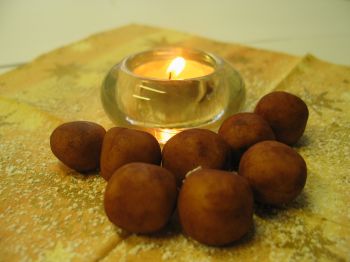
Marzipan Potatoes:


Ingredients: 200g marzipan 100g icing sugar 2cl brown rum 30g cocoa powder To prepare: Knead together the marzipan, icing sugar and rum well, then make into a roll. Cut off equal-size pieces and shape into oval balls. Using a skewer, make irregular indentations in the "potatoes" to resemble the "eyes". Then dust the marzipan potatoes with the cocoa powder until well coated.


Dresdner Christstollen:


Ingredients: 750g flour, 275g butter, 90g sugar, 75g yeast, 185g tepid milk, 500g raisins, 75g chopped sweet almonds, 20g chopped bitter almonds, 70g candied lemon peel, 15g candied orange peel, grated peel of 1/2 lemon, 1 pinch of salt, 1/2 vanilla pod, 1 pinch of ground cinnamon, 1 pinch of ground cardamom, 1 pinch of ground mace. Preparation: Sift some of the flour onto the work surface and make a well in the centre. Break up the yeast, add a little of the milk and sugar and mix to a loose dough. Dust with flour and leave to rest for approx. 15 mins. Next work to a firm dough adding the rest of the flour and milk and the butter cut into pieces. Leave the dough to rest in a warm place for approx. 20 mins. in a bowl covered with a tea towel. Mix the other ingredients well and knead them into the "stollen" mixture. Allow to rest for another 20 mins. then shape into a "stollen" and make two grooves lengthways. Place on a greased baking tray and bake in a preheated oven at 160 degrees C for between 35 and 50 mins. Once cooled, spread generously with melted butter. Leave for 2-3 weeks and then dust with icing sugar before serving.


Pharisäer:


Ingredients: coffee, a swig of rum, whipping cream (100g) and a teaspoon of sugar Make a strong black coffee in a tall glass and add the rum. While the coffee is brewing, mix the sugar with the cream and whip until stiff. Use this to crown your drink and then sit back and enjoy.


2011 Christmas Markets & Fairs:


Thursday, November 18, 2010

Travellers visiting south-west Germany over the coming weeks can enjoy the growing sense of excitement and festive cheer as seasonal markets open throughout the region.

The tourism agency representing Baden-Wurttemberg highlighted a range of festive events that will be getting underway soon, which range from the 'big and bustling' to the 'small and intimate'.

In Bad Wimpfen, visitors can explore one of Germany's oldest Christmas markets and join walking tours led by night watchmen and town guides in period costume.

Another destination worth visiting is Ludwigsburg, near Stuttgart, which hosts a Baroque fair featuring more than 170 stalls, while Gengenbach offers the impressive sight of a giant advent calendar that uses the 24 windows of the 18th-century town hall.

The majority of markets in the region open in the last week of November and run until Christmas Eve. Click here for a complete list of the Christmas Markets.


If you want to visit not only Germany, but want the best of all, we have a very special Christmas Market Tour visiting German, Austria & Switzerland.
Travellers can get to south-west Germany by catching flights to destinations such as Stuttgart, Karlsruhe-Baden Baden and Friedrichshafen, while Frankfurt is also close by.

Tuesday, November 16, 2010

A Visit to Neuschwanstein Castle

Schloss Neuschwanstein is one of the most popular castles in Europe and we are glad that our autumn visit has allowed us to tour the interior of the castle. 
On a previous trip in winter, we could only admire the Neuschwanstein Castle from the village inHohenschwangau. On that occasion our tour did not include a castle visit.  Our tour director wasn’t forthcoming with information on how to get up to the castle and we didn’t have a lot of time to explore on our own.
Visits to the rooms of Neuschwanstein Castlecan only be done as part of a guided tour. Tours are conducted in German and English by Schloss Neuschwanstein guides and for visitors who do not speak these two languages, audio-guides are available in various languages.
The castle tour takes half an hour and visitors are shown through the rooms on the third and fourth floors.  King Ludwig commenced building his castle in 1869, but it was never completed.

King Ludwig’s Fairytale Castle

After King Ludwig II was defeated by the Prussians and was forced to accept domination of his country by Prussia, he decided to retreat to an alternative world of fantasy. Ludwig II had a very romantic view of life in the Middle Ages and thought he could live like a king of the Middle Ages and so the castle that he wanted to build was to be “in the authentic style of the old German knights’ castles”.
Ludwig was also very much influenced by the works of Richard Wagner and the main rooms of Neuschwanstein Castle are decorated with murals of scenes from the Germanic and Nordic sagas on which Wagner had based his works.
On the tour of the castle rooms visitors get to see Ludwig’s monuments to the medieval German knights’ and legends as well as references toTannhäuser, Parzival and Lohengrin, all of whom the king had identified with since he was young.  Particularly impressive were the King’sbedroom, the  Throne Hall, the Festival Hall and the Singers’ Hall.  The Singers’ Hall was one of Ludwig’s favourite projects and is the most important room in the Castle.  (Note: Image to the right is from a print.)
The guide we had was excellent and our only disappointment was that photography is not allowed in the castle.  Also, you do have to move quite quickly through the rooms as with the many visitors coming through, there’s no time to hang around and enjoy the features of this fairytale castle.
The tour ends on the 2nd floor where there is a shop, cafeteria and multimedia room.
Just past the cafeteria is a balcony from which you can get great views towardsHohenschwangau Castle, the village and the surrounding area.  The kitchen on the ground floor can be viewed on your own before you exit the Castle.
If you are visiting Neuschwanstein Castle on your own, note that entrance tickets must be bought at the ticket office in Hohenschwangau villagebefore you come up to Castle. The ticket office will advise you of the possible entrance times.  You will not be able to buy tickets at the Castle itself.  In spite of the inclement weather during our visit, it was very busy so allow time for standing in the queue. During the summer months, the Castle receives about 6,000 visitors each day. Also, allow time for getting up to the castle and back to the village.
Although only a 30-minute tour, a visit to the Neuschwanstein Castle rooms is certainly worthwhile doing.  A great view of the castle is from Marienbrücke.


Search tours to Schloss Neuschwanstein

Monday, November 15, 2010

5 Things you want to know about travelling in Germany


Restaurants and Bars – You do not get water for free, you have to pay for it. If you order water you will get carbonated water. In most restaurants you can request tap water and they may or may not charge you but it is most likely straight from the sink. In some American fast food restaurants, (i.e. McDonalds) you must pay for ketchup as well. Be aware that the menus at most fast food restaurants in Germany are not exactly the same. You may also notice that a sandwich that you recognize from back home may taste a little different or it could be smaller. When you enter a restaurant you will not be seated, just walk right in and pick the table of your choice!- the tip should be much smaller than you would give in the States (this is because the waiters/waitresses get paid more than in the states) A tip of two or three EUR would be considered a good tip for very good service.
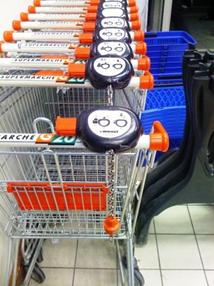
Supermarkets – If you shop for groceries in Germany you will notice the supermarkets have all of their large rolling carts outside in a designated area and they are locked to one another. In order to utilize a cart you must place one EUR in the cart itself, you will see the slot on the handle. Upon leaving the supermarket you latch the cart back to the other carts and pull the device out where you placed the coin, now you can retrieve your coin. When you have all of the groceries you want, proceed to the check-out counter. You will have to purchase plastic bags to put the groceries in or you can take one in yourself. If you decide to purchase one they are usually visible at the counter and normally only cost a few cents. If there is a long line do not put all of your groceries in the bag, put them back into the cart and bag them away from the line.
Closing hours – On Sunday everything is closed except for some restaurants, bars, gas stations and shops at the main train station and bigger airports. Some bigger stores are realizing that they can make much more money if they open on Sunday so they are doing just that, but I would not rely on it. During the week shops in bigger cities close at 8 PM at the latest. You may see shops in smaller cities closing even earlier.
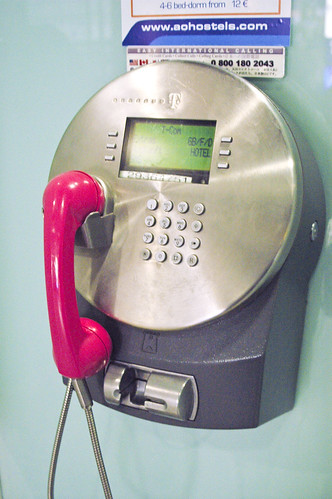
Public Phones – Public phones are very rare in Germany. If you find one you will notice that they only take telephone cards. You can buy a telephone card in different shops like “T-Punkt”, “Telekom”, “Post”, and “Vodafone” or you can go to an Internet cafe.
Miscellaneous – “Bad” in front of a towns name does not mean that the people or the city is bad for example, “Bad Homburg”. Bad in front of a towns name normally means that the town is designated as a healthy location normally with very clean air and water.
For more great tips & special offers for Germany, call us at (800) 949-6362 or go to www.nonstoptravel.net 

Friday, November 12, 2010

Why Does Airline Food Taste so Awful?


Is it actually the food the airlines serve (when they do) that tastes so bad, or is it the flying experience that makes the food taste so awful?
Wired Magazine reported that a handful of brave volunteers made “the ultimate sacrifice for science” and ate airline food. Voluntarily.
Apparently a lab was set up that perfectly simulated the intense dryness, stale air and ear-irritating low pressure of airline cabins.
Germany’s Lufthansa Airlines spearheaded the experiment basically because they wanted some scientific sense of just how air travel affects the taste buds. So the volunteers were jammed into an Airbus A310 fuselage to find out.
From there, the hapless tasters were subjected to motors under the seats recreating the full sense of engine vibrations, while the ”cabin” air pressure was lowered and humidity reduced to a parching 15 percent.
The “flyers” were served various meals, tasted the food and reported back that the “pressurized cabins dulled the senses,” causing food to taste as if it had 20 percent less sugar and salt than it actually did.
Lufthansa says it will correct the mistaste by adding more sugar, herbs and spices to liven up the flavor.
They say they’ll also add humidifiers and pay more attention to aroma.
It seems that the nose feasts before the palate so, according to Ingo Bulow, head of on board services at the airline, “If you serve hot brown water and fill the cabin with the aroma of coffee, people will perceive the drink as coffee.”
Of course they could just serve good coffee and let the natural aroma entice the passengers.
Now there’s a novel idea.